Want to be self-sufficient with food? Here are five tips to get you started

Here are five tips to live off the land. Photo: Getty
So the zombie apocalypse has struck without warning.
There’s no food in your fridge, your cupboards are bare, and you’re not the type to be hoarding a cache of weapons.
Where do you even start looking for food?
Lucky for you, I’ve been living in a hypothetical zombie apocalypse for the past 20 days in an attempt to survive off only what I can catch, grow, or forage for a month.
https://www.youtube.com/watch?v=FMS0JZ4aHJ8
I’m seven kilos lighter than when I started, and despite some struggles – no coffee, no beer, no fun – I’ve actually hit a bit of a groove.
But it hasn’t been a smooth ride getting here, for a novice like myself.
So here are a few things I wish I had known at the outset.
How to make your own salt

Sea water is around 3.5 per cent salt, meaning it’s easy to extract a large amount with minimal effort. Photo: ABC Science/Nick Kilvert
It’s probably way down your list of things you’re worried about the shops ever running out of, but salt is considered to have changed the course of human history.
Being able to preserve food with salt meant we were no longer beholden to seasonal crop availability, and could also make meat last through harsh winters and for travel.
For millennia, rainwater has washed ions from rocks into the ocean, where they have concentrated.
The most abundant of those are things like sodium, chloride, potassium and magnesium, which make up sea salt.
Our oceans are now around 3.5 per cent salt, meaning there’s heaps of it and it’s pretty easy to extract.
Here’s what you’ll need:
- A couple of 10-litre or 20-litre buckets, depending on how much you want to make
- A stove top with at least two cookers
- A long, high-sided pan or oven tray – one that can span your two cookers
- Ideally, you’ll also have a big cooking pot, and somewhere you can have an outdoor fire. That’ll save you some gas or electricity, but it’s not essential.
That’s the what. Check out the video below for the how.
How to grow mushrooms
Fungi are fascinating freaks of the biological world – more closely related to animals than plants.
Some can kill us, others can make us think we’re dying.
Some can make us think we’re flying, and thankfully others are delicious.
The good news is someone else has figured out which is which, and how we can grow tasty ones like pink oysters.
Here’s what you’ll need:
- A 20-litre bucket with a lid
- One of those plastic laundry baskets with all the holes in the side
- One of those 60-ish-litre black bins that the laundry bin can fit inside
- A bag of sugar cane mulch – you can buy that at any gardening or hardware store
- A small bag of hydrated lime – again you can get that at any hardware store, it’s cheap and you only use a tiny bit
- Some micropore tape – you can get that at the chemist
- Most importantly, grain spore, in this case from the pink oyster mushroom.
Pink oysters are a really easy-to-grow species, that tolerate a range of temperatures.
You can make your own, but if you’re starting out, I recommend ordering your grain spore from any one of the dozens of local mushroom sellers online.
That’s all you need. Check the video for what to do next.
Foraging your own food

The bungwall fern has been a staple of indigenous people up the east coast. Photo: ABC Science/Nick Kilvert
This one comes with a big disclaimer: Before you eat any foods you’ve foraged, make sure you are 100 per cent positive of the identification.
That means using plant identification guides and getting an expert to confirm your species and whether it needs special preparation before consuming.
If you’re in the slightest bit uncertain, do not eat it.
And do not use this information here as a comprehensive guide.
A significant number of Australian plants are poisonous, according to Dr Ben Moore.
Many of them produce dangerous toxins like cyanide and strychnine.
Assume everything is trying to kill you, and work backwards from there.
Bungwall (Blechnum indicum)
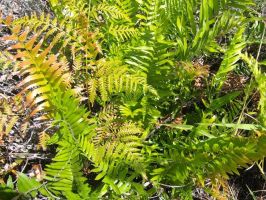
The roots of the bungwall can be eaten raw or roasted and turned into flour. Photo: ABC Science/Nick Kilvert
Bungwall, or further north where it’s called Dugal, has been a staple food of Indigenous people up the east coast of Queensland and New South Wales.
Bungwall typically grows in swampy areas where the ground is sandy and is often found near the coast.
Although the starchy root can be eaten raw, it can also be fried, or baked in a fire and pounded to make flour.
It’s abundant, easy to harvest and filling.
Kangaroo vine (Cissus antarctica)
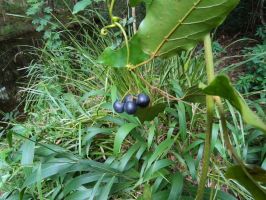
Kangaroo berries can be eaten raw or stewed. Photo: ABC Science/Nick Kilvert
Cissus antarctica is one of a number of native berries in the grape family.
The berry grows on a strong climbing vine which was used by Indigenous people to climb trees, and is found around forested creeks throughout most of eastern Australia.
Water can be obtained from the vine by cutting it and hanging it upside down to drain.
The vines produce an edible fruit – commonly called a kangaroo berry – that can be eaten raw or stewed.
The fruit strongly resembles a blueberry visually, but unfortunately not in flavour.
‘Queensland’ arrowroot (Canna edulis)

Arrowroot is a common edible weed. Photo: ABC Science/Nick Kilvert
Where the name “Queensland” arrowroot came from is unclear, because this weed comes from South America, where it was originally domesticated throughout the Andes.
It can be found growing along creek beds in most Australian states, and produces a large rhizome that can be dug up and eaten.
The rhizome is full of carbohydrates and can be used like a potato.
The best recipe I found for arrowroot was to slice it into strips and fry like potato chips.
–ABC
Want to see more stories from The New Daily in your Google search results?
- Click here to set The New Daily as a preferred source.
- Tick the box next to "The New Daily". That's it.


