The latest super rankings: Fine-tune your account to cash in on the coming recovery


Use the super performance awards to check how your fund is doing. Photo: TND
With coronavirus restrictions lifting across the country, now is a good time to look at the health of your superannuation fund. That way you’ll be sure to make the most of the economic recovery.
But judging the worth of your fund can be difficult, so a useful benchmark is provided by research group SuperRatings’ annual awards for different fund types.
Before you start looking at other funds, though, you need to understand where your money is invested right now.
Look at your last statement. It will detail the name of your fund, your asset allocation, the fees charged, and the fund’s performance over time.
Next, learn more about the assets you hold.
“Not all labels for super funds mean the same thing,” said David Simon of Integral Private Wealth.
“Some funds might be labeled ‘balanced’ but be 90 per cent in growth assets like shares. In that case they should really be called an aggressive growth fund,” Mr Simon said.
Even default MySuper products can be mislabeled, according to Tony Sandercock, the principal of advisory firm wetalkmoney.
“The average default fund which holds 60 to 80 per cent in growth assets should be called a growth option when they’re generally referred to as balanced funds,” Mr Sandercock said.
Be that as it may, about 80 per cent of people are members of a default MySuper fund because they did not actively choose another fund. Defaults hold a quarter of all super investments, or $731 billion, according to financial regulator APRA.
“That allocation has performed well for members,” Mr Sandercock said.
“If you were in the balanced option [where defaults are] this year and you hadn’t looked at your balance since before the pandemic panic, you’d think it just had a flat year because funds have recovered so much,” he said.
The winners
Let’s look at the funds topping the SuperRatings rankings.
The top MySuper ranking was given to Sunsuper, which posted an average annual return of 7.8 per cent over the past ten years.
The top career position, for the fund best catering to members in a particular industry, was building industry fund Cbus’s Growth option with an 8.5 per cent return.

Career-related funds can be important for members in particular industries as they offer appropriate insurance for the level of risk workers face in their jobs.
The top pension fund award went to QSuper’s Balanced fund, which delivered a stunning 8.8 per cent a year over 10 years. Funds in pension mode deliver higher returns because they do not have to pay capital gains tax on their investments, as members are overwhelmingly over 60.
Note that all the funds in these top rankings held between 60 and 76 per cent in growth assets, putting them in the growth or balanced category.
Cross check results
So, if you want to see how your fund is tracking, check it against the above table showing returns earned by SuperRating’s top performers and the median 10-year returns as well. Even if your fund is not at the top of the tree, you are doing ok if it is in line with the median.
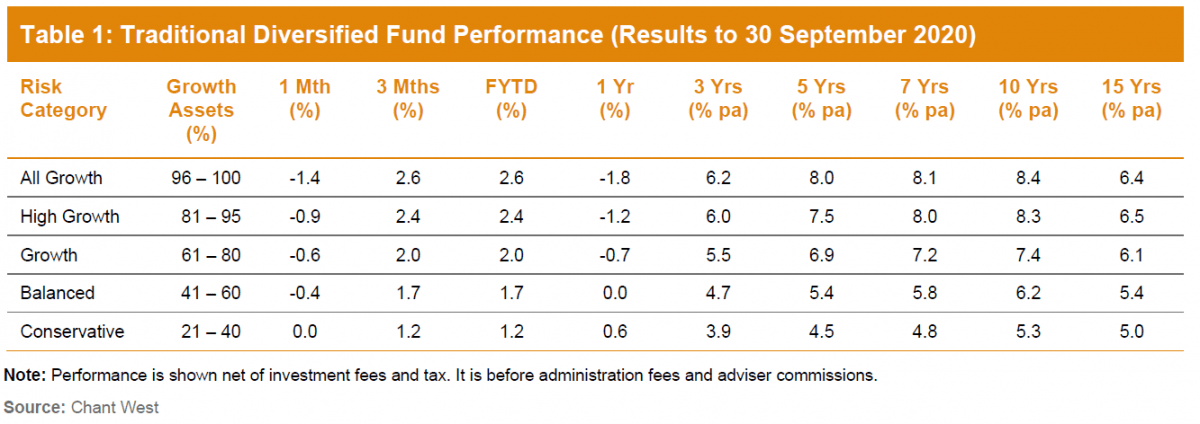
If you are not in a growth or balanced option, check your returns against the below chart from Chant West. It covers all fund types over a range of time periods.
There are a few things to consider when checking the health of your super and making a big move like changing funds.
The first is to determine if you’re in the right asset allocation “and make sure it’s true to its label,” Mr Simon said.
Most major super funds offer intra-fund advice to help you determine what is the right level of risk for you, and often the service is free.
Issues on asset allocation “are driven by age, plans for retirement, your investment understanding and experience, and the time you still have to work,” said Corey Wastle, adviser with Verse Wealth.
Check the fees your fund is charging as they have a big impact on your final balance and are a major driver of underperformance. The Productivity Commission warned in 2019 that underperformance is costing Australians $3.8 billion a year and high fees can cost a worker on $50,000 some $100,000 in retirement.
Be money smart
The other thing to do is to check the government’s MoneySmart website and look under superannuation where you’ll find a super calculator.
You can work out from that how much super you are likely to have at retirement and that could spur you to choose an asset allocation likely to meet your needs.
“If you’re under 45, you want to be in a higher growth option,” said Mr Wastle. “When cash is paying 1 per cent younger people lose out through holding too much in conservative assets.”
A way to ensure you are not overpaying fees is to check the websites of major funds for a comparison. The same is true of insurance costs taken out of your account.
But insurance is about more than costs so check the cover you are getting from your fund and make sure it suits your needs.
Another option for those in the ‘set and forget’ mindset it to “choose a lifecycle option. That moves your money into appropriate allocations as you age,” Mr Sandercock said.
The New Daily is owned by Industry Super Holdings
Want to see more stories from The New Daily in your Google search results?
- Click here to set The New Daily as a preferred source.
- Tick the box next to "The New Daily". That's it.


